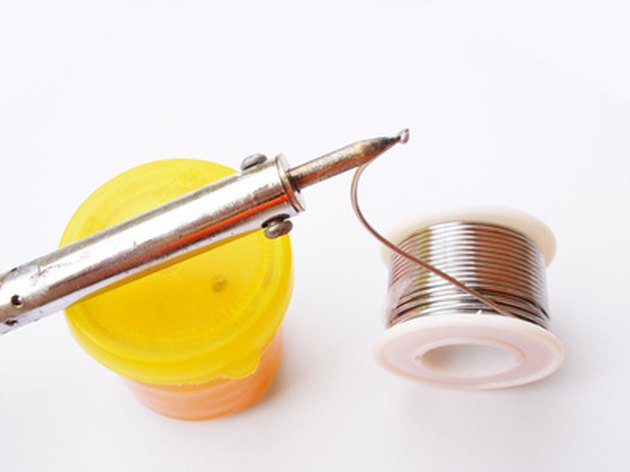
Solder is a fusible alloy used to join less fusible metals or wires, etc. Solder is sold in spools of wire or in bars. Solder wire is comprised of different alloys, or of pure tin. Each metal requires a certain type of soldering wire to create strong bonds, because the combinations of metals that comprise soldering wire melt at different temperatures.
Soft soldering wire that contains lead is comprised of combinations of tin, lead, silver, cadmium and copper. Combinations of tin and lead are most common, in ratios of 60 percent tin/40 percent lead; 63 percent tin/37 percent lead; and 50 percent tin/50 percent lead. These solders melt in a range from 361 to 421 degrees with the higher the percentage of lead, the higher the melting point.
Lead-free soldering wire is comprised of various combinations of tin, copper, silver and antimony. Pure tin wire has the highest melting point of 449 degrees. Other combinations of metals melt in a range between 419 and 441 degrees.
Uses
Lead-free soldering wires include varieties with “no clean” flux that are used in electronics. No clean flux does not leave a residue of foreign particles after fusing. Stainless steel requires an acid core soldering wire. Rosin core wire creates bonds with extra strength.
Cost
Leaded solder wire is less expensive than lead-free solder wire. Prices vary according to the metallic content of each alloy, and the size of the spool.
We can offer all kind of solder wire base on your need . Welcome to send enquiry to us .
Attachment of temperature-sensitive components to printed circuit boards
Step soldering, when a secondary, lower temperature reflow process is required after a standard SAC soldering process is completed
Eliminating warpage of thinner chips due to high-temperature reflow
Low melting or low-Tg flex circuitry which are used in cellphones, smartwatches, and many internet-of-things (IoT) devices
Large area array devices – such as BGAs – to avoid head-in-pillow (HIP) and non-wet-open (NWO) failures
Durafuse LT
Indium Corp has invented a new low-temperature solder paste called Durafuse LT. This new alloy reflows at 200°C and uses a novel solder alloy process to bring mid-temperature solder properties into the upper edge of the low-temperature space. This provides greater drop shock and thermal cycling performance as compared to the typical BiSnAg alloys currently on the market.
Older legacy low-temp options are brittle and tend to crack when stressed, which make them unsuitable for many applications. Durafuse LT is more robust and increases durability in drop shock, not just incrementally, but by a significant measure. In fact, under the right process conditions, Durafuse LT’s performance is comparable to SAC305.
Other low-temperature alloys include:
Indalloy #
Liquidus (°C)
Solidus (°C)
Element 1
%
Element 2
%
Element 3
%
Element 4
%
1E
118
118
In
52.0
Sn
48.0
1
125
118
In
50.0
Sn
50.0
71
131
118
Sn
52.0
In
48.0
281
138
138
Bi
58.0
Sn
42.0
282
140
139
Bi
57.0
Sn
42.0
Ag
1.0
290
143
143
In
97.0
Ag
3.0
87
145
118
Sn
58.0
In
42.0
203
150
125
In
95.0
Bi
5.0
88
150
150
In
99.3
Ga
0.7
225
151
143
In
90.0
Sn
10.0
90
152
152
In
99.4
Ga
0.6
91
153
153
In
99.6
Ga
0.4
2
154
149
In
80.0
Pb
15.0
Ag
5.0
92
154
154
In
99.5
Ga
0.5
4
157
157
In
100.0
204
175
165
In
70.0
Pb
30.0
205
181
173
In
60.0
Pb
40.0
231
186
174
Sn
86.5
Zn
5.5
In
4.5
Bi
3.5
227
187
175
Sn
77.2
In
20.0
Ag
2.8
226
187
181
Sn
83.6
In
8.8
Zn
7.6
Low-Temperature Solder Applications
In addition to soldering, Indium Corp provides low-temperature solutions for thermal management, hermetic sealing, fusible alloys, eye glass lens blocking, and more.
Thermal Management
Alloy systems that are liquid at room temperature have a high degree of thermal conductivity, far superior than ordinary non-metallic liquids. This allows for the use of these materials in specific heat-conducting applications, such as heat dissipation in sensitive components during operation, machining, and/or manufacturing.
Other advantages of these liquid alloy systems are their inherent electrical conductivity. Typical applications for these materials include thermostats, switches, barometers, heat transfer systems, and thermal cooling and heating designs.
Hermetic Sealing
Some sealing operations use pure indium and require no heat at all. The sealing process uses mechanical pressure to create the bond. The softness and malleability of indium, in addition to its ability to retain these characteristics at cryogenic temperatures, allows it to fill in imperfections in mating surfaces to create a hermetic seal.
Fusible Alloys
Low-temperature or fusible alloys are commonly used in a variety of safety devices where they are designed to melt at a peak temperature to initiate a process. Eye glass lens blocking is another application where low-temperature or fusible alloys work well. The lens is held in place using a block of the alloy, which is then easily removed with hot water.
Some common fusible alloys are:
Indalloy
Property
117
158
160-190
217-440
255
281
Property
Indalloy 117
Indalloy 158
Indalloy 160-190
Indalloy 217-440
Indalloy 255
Indalloy 281
Melting Point or Range Deg/F
117
158
160-190
217-440
255
281
Weight lbs/in3
.32
.339
.341
.343
.380
.315
Tensile Strength lbs/in2
5,400
5,990
5,400
13,000
6,400
8,000
Brinell Hardness No.
12
9.2
9
19
10.2
22
Maximum Load 30 sec lbs/in2
—
10,000
9,000
16,000
8,000
15,000
Safe Load Sustained
—
300
300
300
300
500
Conductivity (Electrical) Compared with Pure Copper
3.34%
4.17%
4.27%
2.57%
1.75%
5.00%
We offer all kind of solder product , Pls feel free contact us.

 Solder Factory from China