Industrial News · Science · Unclassified

PCB PCBA Basics

One of the key concepts in electronics is the printed circuit board or PCB. It’s so fundamental that people often forget to explain what a PCB is. This tutorial will breakdown what makes up a PCB and some of the common terms used in the PCB world.

Over the next few pages, we’ll discuss the composition of a printed circuit board, cover some terminology, a look at methods of assembly, and discuss briefly the design process behind creating a new PCB.

Before you get started you may want to read up on some concepts we build upon in this tutorial:

  • What is Electricity?
  • What is a Circuit?
  • Voltage, Current, Resistance, and Ohm’s Law
  • Connector Basics
  • Soldering 101 – PTH
  • Signals

What’s a PCB?

Printed circuit board is the most common name but may also be called “printed wiring boards” or “printed wiring cards”. Before the advent of the PCB circuits were constructed through a laborious process of point-to-point wiring. This led to frequent failures at wire junctions and short circuits when wire insulation began to age and crack.

A significant advance was the development of wire wrapping, where a small gauge wire is literally wrapped around a post at each connection point, creating a gas-tight connection which is highly durable and easily changeable.

As electronics moved from vacuum tubes and relays to silicon and integrated circuits, the size and cost of electronic components began to decrease. Electronics became more prevalent in consumer goods, and the pressure to reduce the size and manufacturing costs of electronic products drove manufacturers to look for better solutions. Thus was born the PCB.

PCB is an acronym for printed circuit board. It is a board that has lines and pads that connect various points together. In the picture above, there are traces that electrically connect the various connectors and components to each other. A PCB allows signals and power to be routed between physical devices. Solder is the metal that makes the electrical connections between the surface of the PCB and the electronic components. Being metal, solder also serves as a strong mechanical adhesive.

Composition

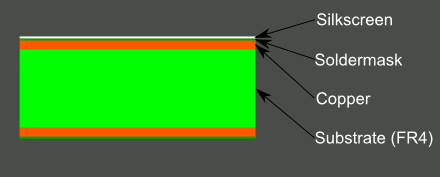
A PCB is sort of like a layer cake or lasagna- there are alternating layers of different materials which are laminated together with heat and adhesive such that the result is a single object.
alt text

Let’s start in the middle and work our way out.

FR4

The base material, or substrate, is usually fiberglass. Historically, the most common designator for this fiberglass is “FR4”. This solid core gives the PCB its rigidity and thickness. There are also flexible PCBs built on flexible high-temperature plastic (Kapton or the equivalent).

You will find many different thickness PCBs; the most common thickness for SparkFun products is 1.6mm (0.063″). Some of our products- LilyPad boards and Arudino Pro Micro boards- use a .8mm thick board.
Perf board

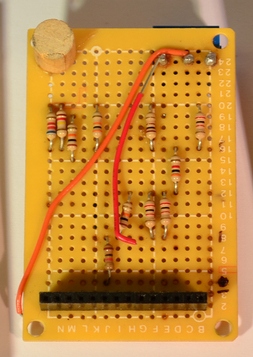
Cheaper PCBs and perf boards (shown above) will be made with other materials such as epoxies or phenolics which lack the durability of FR4 but are much less expensive. You will know you are working with this type of PCB when you solder to it – they have a very distictive bad smell. These types of substrates are also typically found in low-end consumer electronics. Phenolics have a low thermal decomposition temperature which causes them to delaminate, smoke and char when the soldering iron is held too long on the board.

Copper
alt text

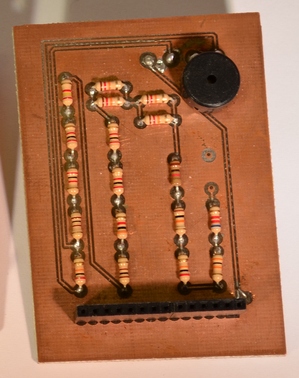
PCB with copper exposed, no solder mask or silkscreen.

The next layer is a thin copper foil, which is laminated to the board with heat and adhesive. On common, double sided PCBs, copper is applied to both sides of the substrate. In lower cost electronic gadgets the PCB may have copper on only one side. When we refer to a double sided or 2-layer board we are referring to the number of copper layers (2) in our lasagna. This can be as few as 1 layer or as many as 16 layers or more.

The copper thickness can vary and is specified by weight, in ounces per square foot. The vast majority of PCBs have 1 ounce of copper per square foot but some PCBs that handle very high power may use 2 or 3 ounce copper. Each ounce per square translates to about 35 micrometers or 1.4 thousandths of an inch of thickness of copper.

Soldermask

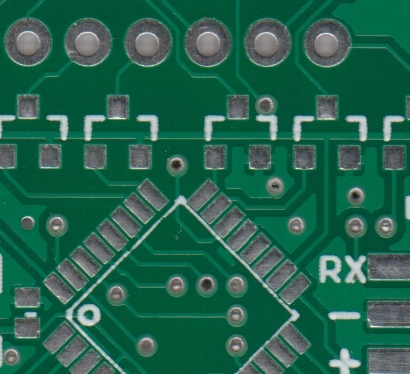
The layer on top of the copper foil is called the soldermask layer. This layer gives the PCB its green (or, at SparkFun, red) color. It is overlaid onto the copper layer to insulate the copper traces from accidental contact with other metal, solder, or conductive bits. This layer helps the user to solder to the correct places and prevent solder jumpers.
alt text

In the example above green solder mask is applied to the majority of the PCB, covering up the small traces but leaving the the silver rings and SMD pads exposed so they can be soldered to.

Soldermask is most commonly green in color but nearly any color is possible. We use red for almost all the SparkFun boards, white for the IOIO board, and purple for the LilyPad boards.

Silkscreen
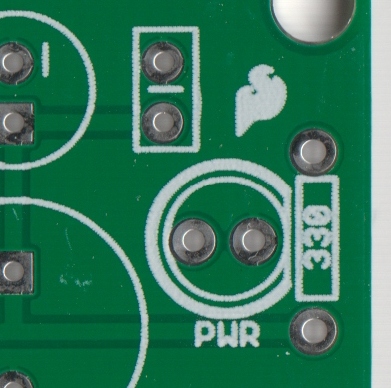
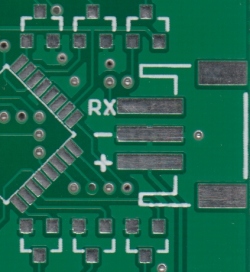
PCB with silkscreen

The white silkscreen layer is applied on top of the soldermask layer. The silkscreen adds letters, numbers, and symbols to the PCB that allow for easier assembly and indicators for humans to better understand the board. We often use silkscreen labels to indicate what the function of each pin or LED.

Silkscreen is most commonly white but any ink color can be used. Black, gray, red, and even yellow silkscreen colors are widely available; it is, however, uncommon to see more than one color on a single board.

Terminology

Now that you’ve got an idea of what a PCB structure is, let’s define some terms that you may hear when dealing with PCBs:

  • Annular ring – the ring of copper around a plated through hole in a PCB.
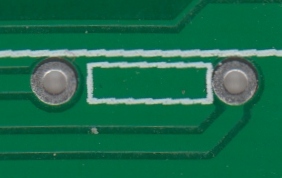
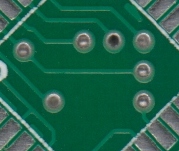
Annular ring on resistor Annular ring on vias

Examples of annular rings.

  • DRC – design rule check. A software check of your design to make sure the design does not contain errors such as traces that incorrectly touch, traces too skinny, or drill holes that are too small.
  • Drill hit – places on a design where a hole should be drilled, or where they actually were drilled on the board. Inaccurate drill hits caused by dull bits are a common manufacturing issue.
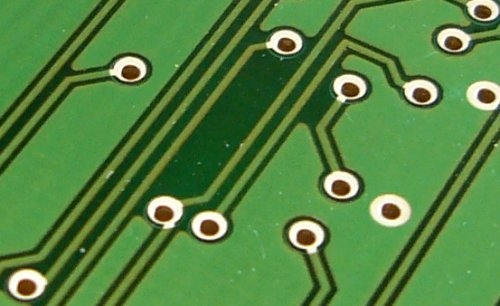
Bad drill hits

Not so accurate, but functional drill hits.

  • Finger – exposed metal pads along the edge of a board, used to create a connection between two circuit boards. Common examples are along the edges of computer expansion or memory boards and older cartridge-based video games.
  • Mouse bites – an alternative to v-score for separating boards from panels. A number of drill hits are clustered close together, creating a weak spot where the board can be broken easily after the fact. See the SparkFun Protosnap boards for a good example.
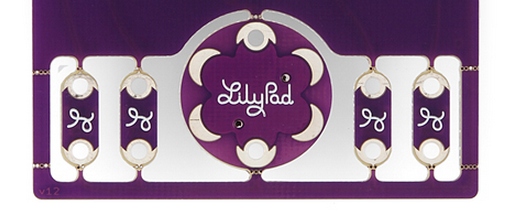
LilyPad Protosnap with mouse bites

Mouse bites on the LilyPad ProtoSnap allow the PCB to be snapped apart easily.

  • Pad – a portion of exposed metal on the surface of a board to which a component is soldered.
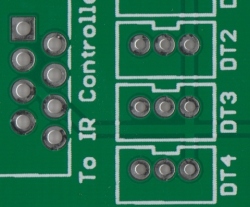
alt text alt text

PTH (plated through-hole) pads on the left, SMD (surface mount device) pads on the right.

  • Panel – a larger circuit board composed of many smaller boards which will be broken apart before use. Automated circuit board handling equipment frequently has trouble with smaller boards, and by aggregating several boards together at once, they process can be sped up significantly.
  • Paste stencil – a thin, metal (or sometimes plastic) stencil which lies over the board, allowing solder paste to be deposited in specific areas during assembly.
  • Plated through hole – a hole on a board which has an annular ring and which is plated all the way through the board. May be a connection point for a through hole component, a via to pass a signal through, or a mounting hole.
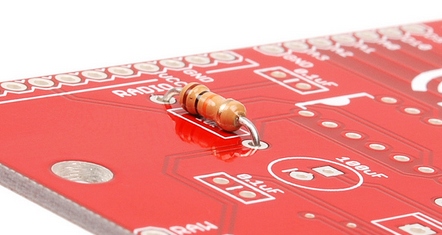
Plated through hole resistor

A PTH resistor inserted into the FabFM PCB, ready to be soldered. The legs of the resistor go through the holes. The plated holes can have traces connected to them on the front of the PCB and the rear of the PCB.

  • Pogo pin – spring-loaded contact used to make a temporary connection for test or programming purposes.
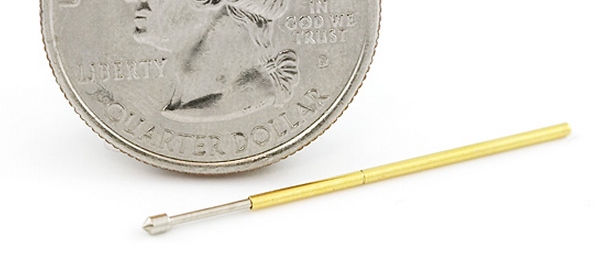
alt text

The popular pogo pin with pointed tip. We use tons of these on our test beds.

  • Reflow – melting the solder to create joints between pads and component leads.
  • Silkscreen – the letters, number, symbols and imagery on a circuit board. Usually only one color is available, and resolution is usually fairly low.
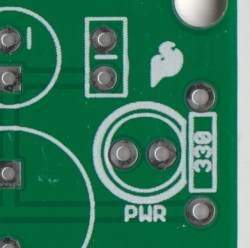
alt text

Silkscreen identifying this LED as the power LED.

  • Slot – any hole in a board which is not round. Slots may or may not be plated. Slots sometimes add to add cost to the board because they require extra cut-out time.


Complex slots cut into the ProtoSnap – Pro Mini. There are also many mouse bites shown. Note: the corners of the slots cannot be made completely square because they are cut with a circular routing bit.

  • Solder paste – small balls of solder suspended in a gel medium which, with the aid of a paste stencil, are applied to the surface mount pads on a PCB before the components are placed. During reflow, the solder in the paste melts, creating electrical and mechanical joints between the pads and the component.
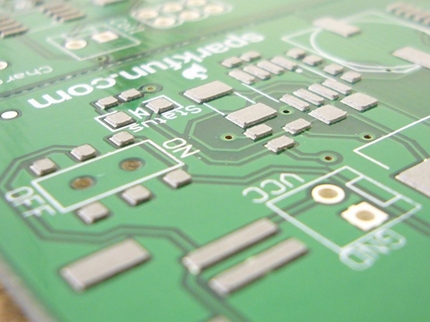
alt text

Solder paste on a PCB shortly before the components are placed. Be sure to read about paste stencil above as well.

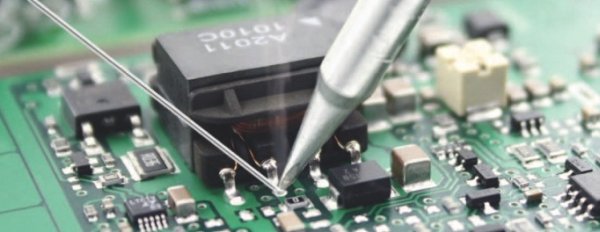
  • Solder pot – a pot used to quickly hand solder boards with through hole components. Usually contains a small amount of molten solder into which the board is quickly dipped, leaving solder joints on all exposed pads.
  • Soldermask – a layer of protective material laid over the metal to prevent short circuits, corrosion, and other problems. Frequently green, although other colors (SparkFun red, Arduino blue, or Apple black) are possible. Occasionally referred to as “resist”.
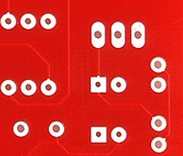
alt text

Solder mask covers up the signal traces but leaves the pads to solder to.

  • Solder jumper – a small, unwanted blob of solder connecting two adjacent pins on a component on a circuit board.
  • Surface mount – construction method which allows components to be simply set on a board, not requiring that leads pass through holes in the board. This is the dominant method of assembly in use today, and allows boards to be populated quickly and easily.
  • Thermal – a small trace used to connect a pad to a plane. If a pad is not thermally relieved, it becomes difficult to get the pad to a high enough temperature to create a good solder joint. An improperly thermally relieved pad will feel “sticky” when you attempt to solder to it, and will take an abnormally long time to reflow.
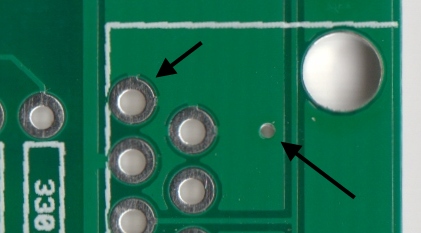
alt text

On the left, a solder pad with two small traces (thermals) connecting the pin to the ground plane. On the right, a via with no thermals connecting it completely to the ground plane.

  • Thieving – hatching, gridlines, or dots of copper left in areas of a board where no plane or traces exist. Reduces difficulty of etching because less time in the bath is required to remove unneeded copper.
  • Trace – a continuous path of copper on a circuit board.
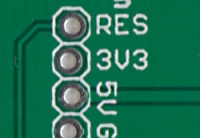
Traces on PCB

A small trace connecting the Reset pad to elsewhere on the board. A larger, thicker trace connects to the 5V power pin.

  • V-score– a partial cut through a board, allowing the board to be easily snapped along a line.
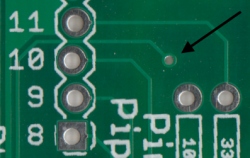
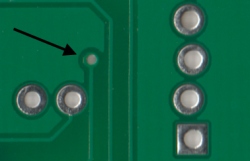
  • Via – a hole in a board used to pass a signal from one layer to another. Tented vias are covered by soldermask to protect them from being soldered to. Vias where connectors and components are to be attached are often untented (uncovered) so that they can be easily soldered.
alt text alt text

Front and back of the same PCB showing a tented via. This via brings the signal from the front side of the PCB, through the middle of the board, to the back side.

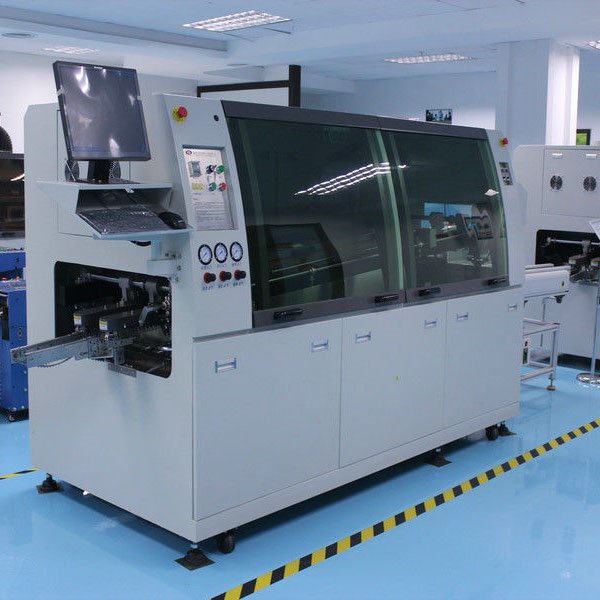
  • Wave solder – a method of soldering used on boards with through-hole components where the board is passed over a standing wave of molten solder, which adheres to exposed pads and component leads.


  • Wave-soldering machine
    Wave-soldering machine
Industrial News · Unclassified

Find the right solder for you

From a wide offer of solders from company Stannol , it´s easy to choose the most suitable type meeting your demands.

The solder matters, it is an undisputable fact confirmed daily in a development and production of electronics. Hand soldering of prototypes, automated machine soldering, soldering of small SMT components or on the in contrast soldering of big joints of massive connectors, rework, … all that wants a solder optimized for a given usage.

As we know, features of a solder wire are determined by an alloy itself (PbSn xx, SnAg xx, …) but in a considerable extent also a flux used. A flux has a big influence mainly on a soldering process, spreading of solder (often even on partially oxidized surfaces), spitting at hand soldering, etc. That´s why despite of often similar specification (according to datasheets), it is still possible to see considerable differences among solders after all. Besides the most important parameters like composition of alloy and flux properties, some features (like spitting and solder spreading) can be really evaluated only at working with a given type.

find-the-right-solder-for-you

Over 130-years experience of German company Stannol give a guarantee, that in their portfolio can be found a type suitable even for your work. In a Stannol catalogue can be found favourite “universal” types suitable for the most types of works in electronics and electrotechnics (for example HS10, HF32, Kristall 400) but also specialized types suitable even for soldering of poorly solderable surfaces.

The principle of Stannol products marking is in it, that they are marked by a flux type (HS10, HF32,…) and by an alloy used (Snxx, SnPb,…). A solder wire is available in many combinations flux / alloy , that´s why it is suitable look at their properties in detail and then to choose a suitable type. On stock we keep the most favorite types with fluxes HS10, HF32 or 2630, suitable for ,majority of joints.

Solder flux · Unclassified

100g and 10CC no clean lead free BGA tacky paste flux

supplies100g per jar or 10CC per syringe no clean lead free BGA tacky paste flux;we have BGA flux,tacky paste flux,no clean paste flux,lead free tacky paste flux.It match with solder wire used together.

 lead free tacky paste flux is formulated to meet the exacting performance and quality requirements of printed circuit board manufacturers. These versatile adhesives feature a unique combination of physical characteristics including:

Consistent, high dot profile
Good green strength
Fast curing
Six-month shelf life at 68°F (20°C) room temperature
Nine-month shelf life at 32°F (0°C)
Resists slumping and stringing with high (>6.0) thixotropic index
Meets IPC-SM-817 Requiements

Performance characterisitic:
Compatible with Lead Free alloys such as
· Reflow-able with peak temperatures up to 270 °C
· Reflow-able in air and nitrogen
· Bright shiny soldered joints with clear residues
· Aggressive flux on various substrates such as
OSP-Cu, Immersion finishes and ENIG
· Clear non-tacky residues
· High tack to minimize skewing of components
· Low voiding
· Stencil Life of 8+ hours (process dependent)
· Classified as ROL0 per J-STD-004
· Compliant to Bellcore GR-78

Specification in details

TF LF-01 Tacky paste flux Introduction:
TF HF-01,tacky Paste Fluxes (TF) are designed to meet and exceed industry standards. It is RoHS standars,halogen- free type of tacky flux. TF LF-01 Tacky paste fluxare used for general touch-up and rework of PCBs, and for the attachment of spheres to BGA and m BGA packages. Operations such as soldering Flip Chip components to various PCB substrates also use TF. TF LF-01 Tacky paste fluxis available in water soluble, no-clean and RMA formulations and can be dot dispensed, screen printed or stencil printed. Available in 10cc syringe; 100g jars; with other sizes available upon request.
PHYSICAL PROPERTIES Specification
The basic physical characteristics

Project Test results
Appearance Light yellow/white tacky paste flux
Smell Not fit for
Physical stability By:5±2 ºC No layered or crystallization precipitation,45±2 ºC no layering phenomenon
Solid content 6.20.2%
Proportion 0.80±0.05
Acid value 19.2 ±1.0 mgKOH/g
Halogen content No
Reliability performance
Project Technical requirements Test result
Water extract resistivity JIS Z3197-86
JIS Z3283-86
By:5.0×10⁴ ohm·cm
Bronze corrosion IPC-TM-650 2.3.32 Pass
Viscosity: / 400-580 kPa.
AgCrO4 IPC-TM-650 2.3.33 Pass
Halogen content JIS Z3197-86
JIS Z3283-86
Pass
Surface insulation resistance
Standard test Conditions Standard Test result
IPC-TM-650
2.6.3.3
40ºC, 95% RH, 96h > 1.0×10¹¹ Ohms 4.9×10¹¹

 Application:

THF-01 Tacky paste fluxis a No Clean Paste Flux designed as a Lead Free Solution for an array of Lead Free interconnect applications such as flip chip attach, sphere or ball attach, rework/repair of CSPs, BGAs, SMDs, or any Lead Free soldering application that requires a very tacky flux.TF LF-01 Tacky paste fluxalso can be used for some lead free solder wire,which can achive the better welding effect.

Application notes:
Standard Applications:
TF LF-01 Tacky paste fluxis designed for stencil/screen printing, rotating drum, slide fluxers and/or syringe applications.
Great for rework applications on all PCB packages of various electronic devices. TF LF-01 Tacky paste fluxis great for rework applications on all PCB packages.
TF LF-01 Tacky paste fluxcan be used in BGA/PGA sphere/pin attachment vehicle or for repair and reballing/repinning. This flux works on flip chip, chip scale package and flip chip bumping sites assemblies as a soldering paste flux.

 Tacky paste flux  could be classified as can/bottle packing and syringe packing type.
Each can/bottle holds the tacky pastes flux is 100g;
Each syringe can load the tacky paste flux is 30g or 10CC
The packing materials can be separated into inner layer of a bubble box and outer package of a paper carton so as to better secure for shipping and transportation.
Specification Tacky paste BGA flux
Appearance White or slight yellow tacky paste
Weight 100g/jar;20jars inner foam carton,paper carton of out pakage
30g/syringe,100syring/carton

Storage, Handling, and Shelf Life:
Refrigeration is the recommended optimum storage condition for TF LF-01 Tacky paste fluxto maintain consistent viscosity,reflow characteristics and overall performance.TF LF-01 Tacky paste fluxshould be stabilized at room temperature prior to printing. TF LF-01 Tacky paste flux fluxshould be kept at standard refrigeration conditions, 0-10°C (32-50°F). Please contact us if you require additional advice with regard storage and handling of this material. Shelf life is 6-10 months from date of manufacture when handled properly and held at 0-10°C (32-50°F).

Health & Safety:
This product, during handling or use, may be hazardous to health or the environment. Read the Material
Safety Data Sheet and warning label before using this product.

Low temperature solder wire · Unclassified

Solder wire low temperature 179 degree melting tin bismuth silver solder wire Sn64Bi35Ag1

Solder wire low temperature 179 degree melting tin bismuth silver solder wire Sn64Bi35Ag1

With the development requirement of world environmental protection,lead free solder wire will gradually replace the tin-lead solder wires. apply for the advanced technology, do research and development more and more special and very usefully lead free solder wire,low temperature solder wire,Tin Bismuth solder wire.
 Tin-Bismuth-silver(Sn64Bi35Ag1) solder wire, with a melting point of 179 degrees C, is ideal for soldering of temperature sensitive components. Supplied as a solid core (no inner flux core) lead free solder wire, this solder gives good wetting and solder flow. Packaged as a 1000g box this solder wire we recommend using with the PF670 flux gel to promote increased rapid wetting.

Low temperature eutectic Tin Bismuth alloy
Prevents thermal damage to heat sensitive devices
Low to non-toxic lead free solder
Available currently in a 0.5mm,0.6mm,0.8mm,1.2mm and 2.0mm diameter.
Packing:1kg/case

supply Sn64Bi35Ag1 tin bismuth silver solder wire,lead free low temperature solder wire,It has following feature.

Feature of Sn64Bi35Ag1 no flux core Bismuth solder wire

  • The most popular lead-free bismuth solder alloys are BBI-W104 (58Bi 42Sn) which melts at 138°C and BBI-W105 (Sn64-Bi35Ag1) which melts at 179°C. The addition of the 1% Ag makes the alloy more malleable. Both alloys can be used for step soldering applications. After the initial joints are made with a standard SAC alloy (220°C) subsequent soldering operations can be done using the bismuth alloys.
  • Sn64Bi35Ag Bi solder wire has joint properties similar to those of tin-lead solders, with superior fatigue and copper dissolution characteristics.
  • Bismuth is the most diamagnetic and the least thermally conductive of all metals
  • In addition to being non-toxic it does not oxidize as readily as lead does.

Feature of other solder wire is also available for Low temperature eutectic Tin Bismuth silver alloy:
Excellent scalability
High quality soldering wire on the market
Refined welding good fluidity, wetting, smoke spatter
Excellent First Pass Solder Joints. JIS Spread ≥ 80%.
Quick acting flue dissolves surface oxides for good wetting
Good solderability, insulation resistance, No spattering and Non-corrosive.
Widely used in electrical and electronics, solder parts like circuit board, electronics devices and others.

The more informations about Sn64Bi35Ag1 middle temperature metiong lead free solder wire,please feel freely contact 

an experienced and professional Chinese soldering manufacturer. We are specializing in research and development, production and selling of the soldering tin materials (solder wire, solder paste, solder bar/stick etc).

More than 10 years specialized in metal industry, accumulated a lot of talent and technology, created international marketing network, for now, we have cooperated with many of oversea enterprises of over 80 countries around the world.e.g.America,Israel,India,Germany,Russia,Poland,LTU,Switzerland,Korea,Romannia,Bulgaria,Colombia,France etc.
Specification of Sn/Bi/Ag low temperature solder wire:
Item:                 Low temperature solder wire
Specification:            BBI-W105(Sn64Bi35Ag1)
1. Purity and chemistry component

Specification Sn64Bi35Ag1- no flux core solder wire
Appearance Lucent,no dirt on surface
Weight Net: 500g/case;1000g/case
Chemistry component
Elements    Specification(%)       Tested result(%WT)
Sn                63.0~65.0                       64.0
Ag                0.8~1.2                           1.0
Al                 0.005                            0.0003
As                0.030                            0.0060
Sb                0.050                           0.0148
Bi                Remainder                    Remainder
Cu                0.080                           0.0003
Fe                0.010                           0.0003
In                0.050                             0.0019
Ni                0.010                            0.0007
Pb                0.050                           0.0257
Cd                0.002                           0.0002
Au                0.050                           0.0010
Ag                0.050                           0.0002
a.       The above concentration of specification are in % weight.
b.       Single value listed are the maximum allowable standard.Flux content(%): 0
Diameter of wire: 0.5mm,0.6mm,0.8mm,1.0mm,1.2mm and 2.0mm

Physical feature of Sn64Bi35Ag1 solid solder wire

Alloy component Melting
point℃
Working temperature℃ Gravity g/cm3 Rigidity  HB Conduct heat
M.S.K
Extend
Mpa
Extend
rate
%
Conductivity  %
Sn64Bi35Ag1 179 100~210 8.5~8.7 11~12 68 45 70-100 18.0

The more informations about Sn64Bi35Ag1 middle temperature metiong lead free solder wire,please feel freely contact us.

Sn64Bi35Ag1 and other tin bismuth wire Application:

Advantages of Bismuth-based Alloys for Low Temperature Pb-free Soldering and Rework.
More and more requirment for middle and low temperature solder wire for moblie electronics,smart-home electronics..

The increased function of personal electronic devices, such as mobile phones and personal music devices, has driven the need for smaller and smaller active and passive components. This trend toward miniaturization, occurring at the same time as the conversion to RoHS-compliant lead-free assembly, has been a considerable challenge to the electronics assembly industry. The main reason for this is the higher reflow process temperatures required for Pb-free assembly. These higher temperatures can thermally damage the PCB and the components. In addition, the higher reflow temperatures can negatively affect the solder joint quality, especially when coupled with the smaller paste deposits required for these smaller components. If additional thermal processing is required, the risk increases even more.

Tin Bismuth Silver solder wire useage.

Packing of tin-bismuth-silver solder wire

Product Type Solder wire Sn64Bi35Ag
Material Tin-Bismuth-Silver alloy
Composition tin64%,bismuth 35%,silver 1%
Melt point 179degree
Flux content  no flux
Application Metal soldering,electronics
Density (g/m^3) 8.3
Diameter 0.5mm,0.7mm,0.8mm,1.0mm,1.2mm,2.0mm
Packing 500g/case,1kg/case
Type no flux core solder wire
Place of origin Shenzhen,Dongguan city
Keyword Tin bismuth silver lead free no flux core solder wire
Solder wire,tin bismuth solder wire,no flux core solder wire Sn64Bi35Ag1
solder


The more informations about Sn64Bi35Ag1 middle temperature metiong lead free solder wire,please feel freely contact us .

Unclassified

Tin lead series powder of type3 Sn63Pb37 and Sn62Pb36Ag2


Tin lead series powder of  type3 and type 4 (20~45micron)Sn63Pb37 and Sn62Pb36Ag2,Sn62.6Pb37Ag0.4 Sn-Pb and Sn-Pb-Ag series solder powder,comon size of powder 20~45micron.

Tin lead series powder of  type3 Sn63Pb37 and Sn62Pb36Ag2 Pb series solder powder 25~45micron.

1.The welding powder is ball shaped,the dark part is a tin rich area and the light part is a lead rich area.The pictures show the good sphericity, homogenous alloy composition and smooth surface of the product.2.Particle size classification and final typing technology enables stable particle size of the product provided to customers.

3. Low oxygen content
Oxygen content is strictly controlled during production and packing of allalloy welding powder.Leco oxygen determinator is adopted to determine the surface oxygen content and chemical assay is adopted to determine the total oxygen content.

4.Advanced powder classification and collection technology enables Type 2-Type 3 alloy welding powder free of powder smaller than 20um.

1.Common alloy composition and characteristics: (appendix)

SN Alloy Brand Solidus Temperature LiquidusTemperature Density g/cm3
1 Sn63Pb37 183 183 8.4
2 Sn60Pb40 193 190 8.8
3 Sn62.6pb37Ag0.4 183 216 9.3
4 Sn62pb36Ag2 183 202 9.13

2.Sn-Pb,Sn-Pb-Ag series powder Product specifications:
B can provide conforms to the J – STD – 005 standard specifications welding powder products; Typical particle size distribution table as follows, if you have any special request, please contact with us (another schedule).

Specification Particle size classification Particle size Reference Standard
2.5# -230/+500
-230/+500mesh
>63μm 25-63μm <25μm J-STD-005
max1wt% min85wt% max5.0wt%
2.3# -230/+400
-230/+400mesh
>63μm 38-63μm <38μm
max1wt% min85wt% max5.0wt%
3# -325/+500
-325/+500mesh
>45μm 25-45μm <25μm
max1wt% min85wt% max10.0wt%
4# -400/+500
-400/+500mesh
>38μm 20-38μm <20μm
max1wt% min85wt% max10.0wt%

3.Sn-Pb,Sn-Pb-Ag series powder oxygen content: (appendix)

specification particle size oxygen content(ppm)
2.5# 25-63μm <80
2.3# 38-63μm <70
3# 25-45μm <90
4# 20-38μm <120
5# 15-25μm <180
6#、7# 5-15μm <220

Usage of Sn63Pb37 ,Sn62Pb36Ag2 and Sn62.6Pb37Ag0.4 tin lead,tin lead silver series solder powder
spherical alloy solder powder, under accurate monitoring by the computer,are  carrying out the high quality standard of the alloy solder powder, can satisfy with the high quality demand of the solder paste . We can also according to customer requirements produce all kinds of special performance products.

Packaging:All  powder is packaged in 5kg metallized mylar bags under inert gas. FIVE bags are packed in sealed polyethylene containers to prevent damage. Alternative packaging is available to satisfy customer requirements.
20kg/case20-25kg

soldr wire,solder paste,solder power,solder bar, flux, red glue manufacturer in China , please feel free contact us .

SOLDER BAR · Unclassified

Tin lead solder bar wave welding solder alloy bar

Tin lead solder bar wave welding solder alloy bar

For soldering applications which require maximum reliability of solder joints, especially for surface mounted omponents, only solder of the highest purity is acceptable. We do not make any vague claims of outstanding solder purity. Complete analysis of Bar Solders prove that every batch conforms to the strictest quality control standards in the solder industry. Sn60Pb40 bar solder weight about 0.78kg/pc,package with 10kg per carton.
bar solders have been exported to such as Colombia,Mexico,Russia,Canada,Netherlands,Iran,Dubai,Saudi Arabia,Vietnam,if your are interested in our solders,pls send us e-mail through website,we will feedback to you within two working days.

Feature:
1.    Favorable fatigue resistance and outstanding performance
2.    Ultra high electrical conductivity
3.    Mid-temperature soldering, characterized by nice softness and wonderful wetting property.
4.    Benefit from activated rosin core flux.
5.    Ultra strong oxygen resistance. Due to the anti-oxygen material in the solder wire,Sn63Pb37 no clean solder wire can give strong resistance to oxygen.

Low Dross Characteristics:giving cost effective use of the solder alloy.
Low Dross Characteristics:reducing the amount of dross in the wave pot leading to lower downturn and reducing the chance of oxide entrapped in joints.
Manufactured to Alpha’s high standards: giving a product that can be relied on to give good consistent soldering performance.

Chemical content:

Impurity content %
Sn Pb Sb Ag Cu Fe Zn Bi Al As Ni Cd
60±2 40+/2 ≤0.10% ≤0.02% 0.1% ≤0.02% ≤0.001% ≤0.10% ≤0.001% ≤0.03% ≤0.01% <0.01%
59.3 bal 0.032 0.0002 0.0057 0.002 0.0015 0.006 0.0024 0.0021 0.0032 0.0001

Maximum Allowed Impurities
solder Bar Solder meets the requirements of current industry standards for allowable impurity requirements. Elements are considered impurities if they are not listed as components in the composition of the alloy.

Storage and Shelf Life:
Sn60Pb40 bar solder has no limited shelf life when handled properly.rage must be in a dry,non-corrosive environment. The solder surface may lose its shine and appear a dull shade of gray. This is a surface phenomenon and is not
detrimental to product functionality.

Tin-lead solder bar size as follow:

Alloy composition
Sn/Pb
Specific gravity Liquid  temperature Temperature Application
63/37 8.39 183 220~240 Computers, precision   instruments, meters, TV,
60/40 8.65 190 230~250 micro technology, coating metals
55/45 8.75 200 240~260 Calculators, tape recorders, telephones, quartz and
50/50 8.85 216 255~275 other common electronic and electrical products
45/55 8.97 227 270~290
40/60 9.30 238 295~310 General circuit boards, toys, lamps, crafts, water tanks, plumbing solder
30/70 9.70 260 310~325
20/80 10.05 275 325~335 General circuit boards, toys, lamps, crafts, water tanks, plumbing solder

Sn60Pb40 Solder bar for wave-soldering;
Solder bar for dip soldering;
Solder bar for auto water tank;
Solder bar for industry electroplating.

Health & Safety:
This product, during handling or use, may be hazardous to health or the environment. Read the Material
Safety Data Sheet and warning label before using this product.

Packing
Size:32×1.8×1.2×2.0 cm; weight 0.78-0.83kg/pc
Packing:10kg/crton; 30kg/export carton
Dimension of carton:36x26x18cm

Shipping:
We guarantee to ship out within 48 hours after payment confirmation (except Holiday).Once the payment is received please allow 48 hours for dispatch of the order.

Country Processing Time Arrive time
United States 2 days 7-15 days
United Kingdom 2 days 7-15 days
Australia 2 days 8-18 days
Canada 2 days 8-18 days
Netherlands 2 days 8-18 days
Spain 2 days 15-25 days
Italy 2 days 15-25 days
Germany 2 days 15-25 days
Other Countries 2 days 2-3 weeks

Contact:
All emails will be answered within 24 hours.
Please leave a message in the Trade Manager.
If you do not receive our reply, please kindly re-sent your email and we will reply you as soon as possible . If you email us and dont hear a reply, please email again through the Alibaba system as sometimes our mail servers have errors

Unclassified

100g tube packing solder paste syringe solder paste

Syringe solder paste is a no-clean tacky soldering flux formula that possesses a high activity level, allowing it to solder nickel surfaces.
The robust wetting action of this solder paste will allow OSP treated copper, as well as heavily oxidized copper, surfaces to exhibit good soldering properties, even after 2 or 3 thermal cycles. Following reflow, syringe tube packing solder paste will leave aesthetically pleasing clear residues on the assembly.syringe solder paste is designed for a wide range of temperature and humidity conditions,they are used for dispensing soldering technique.
produces syringe packing solder paste with 100g/piece,100pieces per foam carton;We can add some ice bag into carton to keep the solderbility and storage situation of solder paste according to customers’ requirement.

Tube solder paste are available:lead free solder paste SAC305,SAC0307,SAC105,Sn42Bi58,Sn64Bi35Ag1
lead-tin syringe solder paste:Sn63Pb37;Sn62Pb36Ag2
Sizes of syringe solder paste:type3,type4,type5,type6 and type7.

Feature

Excellent wettability and solderability;
Transparent residue and low solder ball rate;
Keep the stability in tackiness force of solder paste over 24hr.;
No change in viscosity during continuous printing;
Good spreading and bright solder joint.
Usage: Suitable for re-flow soldering
Briefly profile of Sn99Ag0.3Cu0.7 syringe solder paste
Sn99Ag0.3Cu0.7 is made with solder blenders, It is lead free, organic acid, water-soluble solder paste that provides users with the highest level of consistency performance. Batch after batch, SAC0307 provides hours of stable stencil life, tack time and repeatable brick definition. SAC0307 robust printing characteristics result in consistent solder paste volume regardless of idle time, stencil life and print speed.

The activator package in the SAC0307 is very aggressive and provides superior wetting to OSP coated and Immersion Silver boards. Generally used is type3 and type 4 powder.

syringe packing solder paste with 100g/piece,100pieces per foam carton;We can add some ice bag into carton to keep the solderbility and storage situation of solder paste according to customers’ requirement.
(Specification and chemistry component)
Specification Sn99-Ag0.3Cu0.7
Appearance black tacky paste
Weight 100g/syringe;10kg/ctn,100syringes per foam carton Metal composition of syringe Sn99Ag0.3Cu0.7 solder paste

Sort Chemical composition (wt.%)
Sn Pb Sb Cu Bi Ag Fe Al Cd
Sn99Ag0.3Cu0.7 Bal. < 0.10 <0.10 0.7+/_0.1 <0.10 0.3±0.05 <0.02 <0.002 <0.002
SAC0307 high temperature lead free solder paste is ideal used for precious computer motherboard, phone motherboard, printed circuit board (PCB), LED and SMT technique,as well as high-precision electronics circuit board. solder paste.
Packing:
The SAC0307 high temperature lead free solder paste could be classified as can/bottle packing and syringe packing type.
Each can/bottle holds the solder cream is 500g;
Each syringe can load the solder cream is 100g
The packing materials can be separated into inner layer of a bubble box and outer package of a paper carton so as to better secure for shipping and transportation.
Specification and chemistry component)
Specification Sn99-Ag0.3Cu0.7
Appearance Black and gray tacky paste
Weight 500g/jar;10kg/ctn:500g/can or 100g/syring

Storage, Handling, and Shelf Life:
Refrigeration is the recommended optimum storage condition for Sn99Ag0.3Cu0.7 pb free copper solder pasteto maintain consistent viscosity,reflow characteristics and overall performance.Sn99Ag0.3Cu0.7 copper solder pasteshould be stabilized at room temperature prior to printing. Sn99Ag0.3Cu0.7 silver copper solder pasteshould be kept at standard refrigeration conditions, 0-10°C (32-50°F). Please contact us if you require additional advice with regard storage and handling of this material. Shelf life is 6-10 months from date of manufacture when handled properly and held at 0-10°C (32-50°F).

Health & Safety:
This product, during handling or use, may be hazardous to health or the environment. Read the Material
Safety Data Sheet and warning label before using this product.

we are solder wire,solder paste,solder power,solder bar, flux, red glue,and so on , please feel free contact us .


Solder products · Unclassified

Lead free tin Solder paste type 7 silver solder paste SAC305

Type 7 silver solder paste SAC305
Solder paste is a form of solder that is used in PCB assembly, and including prototype PCB assembly, especially when using reflow soldering techniques. The solder paste is a mixture a solder spheres and a specialized form of flux. This means that the solder forms a form of paste that can be printed onto the surface of the printed circuit card in the required.

type 7(2~12micron) solder paste SAC305 that is Sn96.5Ag3.0Cu0.5 is a no-clean formula. The residues do not need to be removed for typical applications. AlthoughSAC305 is designed for no-clean applications, its residues can be easily removed using automated cleaning equipment (in-line or batch) with a variety of readily available cleaning agents.
Clients Zone:
For now,our type 7 SACX305 solder paste expored to Israel,Canada,Germany,France,Mid-Eastern Asia countries,and part of Eastern European contries.
we are appreciated your kindly inquiry and cooperations with you,if you are interested in our items.
type seven Sn96.5Ag3.0Cu0.5 no clean solder paste does require refrigeration if left at room temperature 3-10 degree for 6 months shelf life.
type 7 Sn96.5Ag3.0Cu0.5 Solder paste basics
The solder particles are a mixture of solder. Traditionally this used to be tin and lead, but with the legislation being introduced around the world, there is a move to lead free solders. These may be made from a variety of mixtures. One is 96.5% tin and 3.0%silver and 0.5% copper, which has exllent soldering result performent.
supply type 7 Sn96.5Ag3.0Cu0.5 silver solder paste has following feature:
1)Can print down to 8 mil x 8 mil apertures
2) Designed specifically for fine feature printing with T7 powder
3)Low QFN/BGA voiding
4) Excellent solderability with halogen-free chemistry
5)Optimized flux residues to mitigate head-in-pillow defects
6)Capable of print speeds up to 6 in/sec (150mm/sec)
7)Low slump behavior minimizes defects
supply type 7 silver solder paste,just as the following specification,our solder paste are highly appreciated by clients arround the world.
Test Content–
Test Item Test Result Test Method
Copper Plate Corrosion Test Pass JIS-Z-3197, 8.4.1
Spread Test > 75% JIS-Z-3197, 8.3.1.1
Copper Mirror Test Pass IPC-TM-650, 2.3.32
Viscosity Test(25 °C,10rpm) 220 ± 30 Pa • s JIS-Z-3284. Annex 6
Tackiness Test (gf) > 130 (8hr) JIS-Z-3284. Annex 9
Slump Test Pass JIS-Z-3284. Annex 7, 8
Solder Ball Test Pass JIS-Z-3284. Annex 11
–Reliability Test–
S.I.R. Test ◊ > 1×10⁹ Ω , Pass IPC-TM-650, 2.6.3.3
Electro Migration Test ♦ Pass IPC-TM-650, 2.6.14.1
◊ Test Conditions: 85 °C, 85% RH for 168 hrs ♦Test Conditions: 65 °C, 85% RH for 596 hrs
–Alloy Composition–
(Sn) (Ag) (Cu) (Ni) (Ge) (Zn) (Al) (Sb) (Fe) (As) (Bi) (Cd) (Pb)
REM. 2.8~3.2 0.3~0.7 0~0.01 0~0.01 0.001 MAX 0.001 MAX 0.05 MAX 0.02 MAX 0.03 MAX 0.10 MAX 0.002 MAX 0.05 M

Type 7 SAC305 solder paste REFLOW TIME PROFILE
Heating rate the time required to 120 ºC constant tem.
130 – 170ºC peak tem. > 220°C cooling rate
1-3 ºC/sec < 60—90secs 60—120secs < 245 ±5ºC < 40—80secs <4ºC / S
Storage, Handling, and Shelf Life:
Refrigeration is the recommended optimum storage condition fortype7 SAC305 lead free solder pasteto maintain consistent viscosity,reflow characteristics and overall performance. SAC305 lead free solder pasteshould be stabilized at room temperature prior to printing. SAC305 lead free solder pasteshould be kept at standard refrigeration conditions, 0-10°C (32-50°F). Please contact us if you require additional advice with regard storage and handling of this material. Shelf life is 6-10 months from date of manufacture when handled properly and held at 0-10°C (32-50°F).
Small knowledge of type 7 Sn96.5Ag3.0Cu0.5 silver lead free solder paste
How to use solder paste
When solder paste is used in mass PCB assembly as well as prototype PCB assembly there are a number of stages that are undertaken. First solder paste is applied to the printed circuit boards. The solder paste is only applied to the areas where solder is required. This is achieved using a solder paste stencil that only allows the solder paste through in certain areas. (Further information is available on another page in this section of the website).

Once the solder paste has been applied to the printed circuit board, it is then passed into the pick and place machine where the components are added. The solder paste has sufficient tension that it holds the components in place. However care should be taken not to knock the board at this stage otherwise the components may move of fall off. Additionally the board should be soldered within a few hours of being placed, otherwise the solder paste may deteriorate.
Any further information,please feel free to consult  technician team.
Application of type7 SAC305 solder paste:
1)can supply jar packing of 500g used for stenciling solder technique,SMD,SMT technology.
2) can supply syring tube packing of 100g,which is used for dispensing technique,for some high quality electronics.
type7 solder paste packing Details:
Packing could be classified as can/bottle packing and syringe packing type.
Each can/bottle holds the solder cream is 500g;
Each syringe can load the solder cream is 100g
The packing materials can be separated into inner layer of a bubble box and outer package of a paper carton so as to better secure for shipping and transportation.
Specification Sn96.5Ag3.0Cu0.5 type7
Appearance gray tacky paste
Weight 500g/jar or 100g/syringe;10kg/carton
we are solder wire,solder paste,solder power,solder bar, flux, red glue,and so on , please feel free contact us .

Unclassified

About us

We are a professional enterprise in the development, manufacturing and sales of innovative materials used in the electronic assembly process. As a full line supplier of reflowing Solder Paste, Cored Wire and bar Solder, metal powder, non-ferrous metal alloy wire, lanthanon permanent magnet, BGA Soldering Fluxes, SMD Adhesives, and some chemical materials soldering.  metal solders and alloy products could meet up to international and domestic standard.

More than 23 years specialized in metal industry, accumulated a lot of talent and technology, created international marketing network, for now, We have cooperated with many oversea enterprises of over 100 countries around the world.

As the industry demands higher performance and more rapid technology implementation, We see the answers coming from its intimate knowledge of materials and processes. We are uniquely qualified to provide you with the total process solutions you are looking for. We accomplish this by applying innovative thinking, creativity.

History
Since our founding in 2000 as a tin alloy metals smelter and refiner sales department has been committed to developing and manufacturing excellent quality and high technical solder metals and electronic materials. Now we has been a quite complete enterprise of product innovation, custom formulations, or answers to challenging technical questions.

We have our own scientific research institution, gathered a set of senior technicians, and managers and established strict management system and perfect quality guarantee system till 2005.

Keep pace with the times
As the industry demands higher performance and more rapid technology implementation,We see the answers coming from its intimate knowledge of materials and processes. We are uniquely qualified to provide you with the total process solutions you are looking for. We accomplish this by applying innovative thinking, creative.